

As temperatures climb across the UK, many of us are experiencing conditions that are becoming more and more frequent to endure.
For some, it means uncomfortable commutes, sleepless nights, and a constant search for shade. For others (particularly those working outdoors, exercising, attending events, or caring for vulnerable individuals), the consequences can be far more serious.
Heat illness is often associated with deserts, jungles, and remote expeditions. Yet every year, people develop heat-related illnesses in parks, gardens, sports fields, festivals, workplaces, and even their own homes.
As our climate changes and periods of extreme heat become more frequent, understanding how heat affects the body is no longer just relevant to expedition medics. It’s becoming essential knowledge for everyone.
Heat Illness Is A Spectrum
Note, it is not always linear.
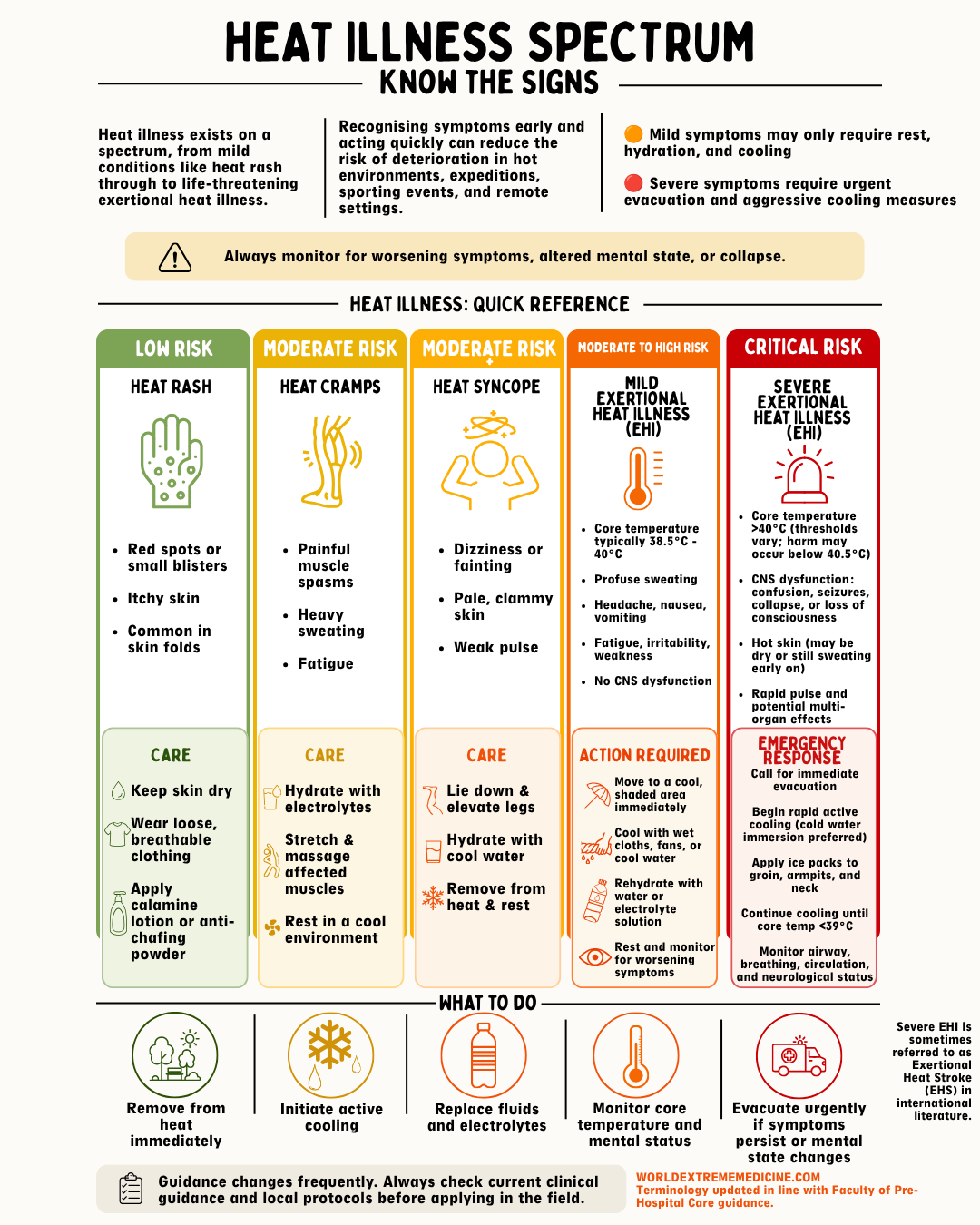
One of the biggest misconceptions about heat illness is that it appears suddenly, but in reality, heat illness exists on a spectrum.
Most people do not go from feeling well to developing heat stroke without warning. The body often provides several opportunities to recognise a problem and intervene before it becomes life-threatening.
Although it is not always linear, the progression is often described as this:
Heat Rash
Often known as prickly heat, heat rash occurs when sweat glands become blocked, causing itchy red spots or small blisters. While usually mild, severe or widespread rash can impair sweating locally, but mild prickly heat doesn’t meaningfully reduce whole-body thermoregulation.
Heat Cramps
Painful muscle spasms in the legs, arms, or abdomen can occur following significant fluid and electrolyte losses through sweating. These cramps are often an early warning sign that the body is struggling to maintain balance.
Note with regards to heat cramps: although the statement of it being an early warning sign is Often true, this is not universal. Heat cramps can occur in otherwise stable individuals, especially athletes with electrolyte imbalance, so they’re not always a precursor to more severe illness.
Heat Syncope
Heat syncope refers to dizziness or fainting caused by reduced blood flow to the brain. As blood vessels dilate to help lose heat, blood pressure can fall, particularly when standing still for long periods.
Heat Exhaustion
Heat exhaustion develops when the body’s cooling systems are struggling to keep up with environmental demands.
Common symptoms include:
- Fatigue and weakness
- Headache
- Dizziness
- Nausea or vomiting
- Excessive sweating
- Muscle cramps
- Increased thirst
- Irritability or reduced concentration
- Pale, clammy skin
At this stage, prompt cooling and hydration can often prevent further deterioration.
Heat Stroke
Heat stroke is a medical emergency.
It occurs when the body’s thermoregulatory systems begin to fail, leading to dangerously elevated core temperatures and neurological dysfunction. Without rapid intervention, heat stroke can lead to organ failure, long-term disability, and death.
Why Heat Illness Happens
The human body is remarkably effective at regulating temperature. A region of the brain called the hypothalamus acts as the body’s thermostat, so, when temperatures rise; it triggers a series of responses designed to keep us cool:
- Increased sweating
- Increased blood flow to the skin
- Increased heart rate and cardiac output
- Behavioural responses such as seeking shade and drinking fluids
Problems occur when heat gain exceeds heat loss, this may happen because of:
- High environmental temperatures
- High humidity preventing sweat evaporation
- Physical exertion
- Dehydration
- Poor acclimatisation
- Heavy clothing or protective equipment
- Alcohol consumption
- Certain medications including antidepressants, antihistamines, anticholinergics, and diuretics
- Illnesses causing vomiting or diarrhoea
Research shows that when the body’s compensatory mechanisms become overwhelmed, circulation begins to suffer, inflammation increases, and organs can become damaged.
Heat stroke can resemble sepsis in more severe cases (systemic inflammatory response, organ dysfunction), but this is more common in exertional heat stroke and advanced presentations, with widespread systemic inflammation and multi-organ dysfunction.
The Most Important Red Flag: Changes In Mental State
If there’s one thing expedition medics, event medics, and emergency clinicians pay particular attention to: it’s changes in behaviour.
A person who is simply hot and tired may have heat exhaustion, a person who becomes confused, disorientated, agitated, irrational, collapses unexpectedly, or has a seizure should be assumed to have severe heat illness until proven otherwise.
Warning signs include:
- Confusion
- Poor decision-making
- Loss of coordination
- Agitation or unusual behaviour
- Reduced responsiveness
- Collapse
- Seizures
- Loss of consciousness
This change in mental status is one of the clearest distinctions between heat exhaustion and heat stroke, and when these symptoms develop, urgent medical attention is required.
What To Do If Someone Develops Heat Exhaustion
Early intervention matters, if someone is showing signs of heat exhaustion:
- Move them into shade or a cooler environment.
- Remove unnecessary clothing.
- Encourage fluid intake if they are conscious and able to drink safely.
- Consider electrolyte replacement if sweating has been significant.
- Apply cool water to the skin.
- Use fans to increase evaporative cooling.
- Apply cold packs to the neck, armpits, and groin if available.
- Monitor them closely for any deterioration.
Most people should begin improving within 30 minutes (note that some people improve faster, others slower. NHS guidance is more cautious: if not improving within ~30 minutes, escalate care). Regardless, if symptoms persist, worsen, or neurological symptoms develop, seek urgent medical assistance.
What To Do If You Suspect Heat Stroke
Heat stroke is a time-critical emergency, while waiting for emergency services:
- Remove the person from the heat immediately.
- Begin active cooling without delay.
- Apply cold water and fan aggressively.
- Use ice packs (where available).
- Monitor airway, breathing, circulation, and consciousness.
- Continue cooling until professional medical help arrives.
One of the practical techniques discussed on our recent Expedition & Wilderness Medicine Course in Plas Y Brenin was the T.A.C.O. method (Tarp-Assisted Cooling with Oscillation), shared by WEM Faculty member Rich Griffiths and demonstrated to our attendees.
When treating severe heat stroke, rapid cooling is critical. Cold-water immersion remains the gold standard, with evidence consistently showing that reducing core temperature as quickly as possible improves outcomes. However, in remote environments, at sporting events, or during expeditions, access to an immersion tub is often unrealistic.
That’s where the T.A.C.O. method may offer a practical field alternative when immersion is not available.
Used by some athletic trainers, military teams, and pre-hospital responders, the technique creates an improvised cooling system using equipment that may already be available in the field. While it is less widely standardised than cold-water immersion, and the evidence base is smaller and largely drawn from operational and field settings, it is recognised as a practical option when conventional immersion is not possible.
The process is straightforward:
- Lay a waterproof tarp on the ground.
- Position the casualty in the centre and remove excess clothing.
- Add cold water and ice (if available) around the body.
- Lift the edges of the tarp and gently oscillate the water back and forth.
- Ensure the head and airway remain supported and above the water level at all times.
The constant movement of water is what makes the technique effective. By continuously moving cooler water across the skin, the method aims to increase heat transfer and improve cooling compared with simply applying static water or ice.
While hopefully a situation most of us will never encounter, techniques like T.A.C.O. demonstrate how understanding the principles behind heat management can help clinicians, event medics, expedition leaders, and responders adapt evidence-informed interventions to challenging environments where resources may be limited.
For those interested in seeing the technique in action, there are several demonstrations available online showing how a T.A.C.O. system can be assembled and used in an emergency.
The goal is rapid reduction of core body temperature, in emergency medicine, there is a simple principle:
Cool first. Transport second… Every minute matters.
Prevention Is Better Than Treatment
One of the most valuable lessons from wilderness and expedition medicine is that prevention is usually easier than treatment.
Simple measures can dramatically reduce risk:
- Drink regularly rather than waiting until you’re thirsty.
- Replace electrolytes during prolonged sweating.
- Wear loose, breathable clothing.
- Seek shade whenever possible.
- Schedule strenuous activity during cooler parts of the day.
- Take regular rest breaks.
- Avoid excessive alcohol.
- Learn to recognise the early warning signs.
Acclimatisation is equally important.
Studies suggest the body gradually adapts to heat exposure over several days through increased plasma volume, improved sweating efficiency, and better sodium conservation. This is one reason why sudden exposure to hot conditions often carries a greater risk than heat exposure that increases gradually.
Heat Is Becoming A Bigger Public Health Challenge
Heat-related illness is no longer a niche topic, globally, heatwaves are becoming more frequent, more intense, and longer lasting. Heat affects not only healthy individuals exercising outdoors but also people with cardiovascular disease, respiratory disease, diabetes, kidney disease, mental health conditions, and those taking medications that affect thermoregulation.
Many heat-related deaths occur outside officially declared heatwaves, reminding us that heat risk doesn’t begin and end with weather warnings.
Whether you’re working outdoors, training for an endurance event, attending a festival, caring for vulnerable family members, or planning an expedition overseas, understanding heat illness can help you recognise problems earlier and act more effectively.
→ Check out our courses
→ Discover more about World Extreme Medicine