

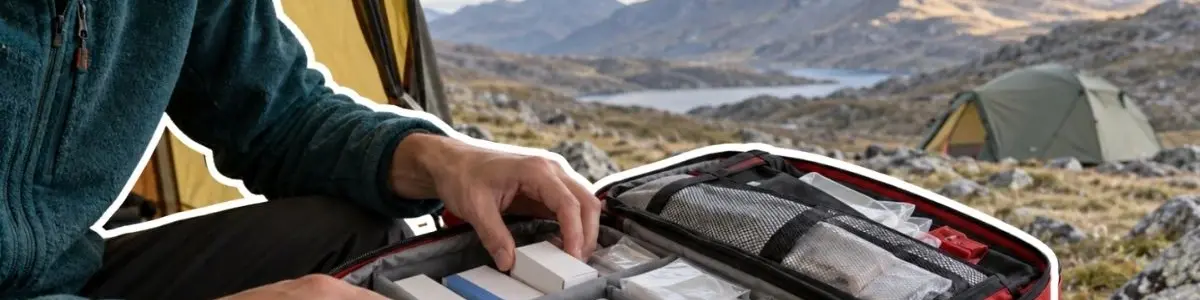
Have you ever thought about how your medical kit has had a journey of its own?
You’re on an adventure as the lead medic of a team, and as you go to reach for your kit to begin triaging a team-mate, you suddenly think about the adventure your own kit has been on… It might have travelled through airports, spent hours in a vehicle and been carried into camp, and, along the way, the conditions around it may have changed rather considerably.
That makes storing medicines on expeditions part of the preparation and focus from the outset and throughout. And choosing what to take is closely connected to how you will look after it, how long you need it to last, and (for us, the most important thing) what you will do if supplies become unusable.
The same applies to the personal medication that helps someone stay well throughout a trip. That could be an inhaler, insulin or another regular treatment needs a place in the plan, alongside the team medical kit.
Further reading and all sources are available at the bottom of this post!
Start with the journey your medicines will take
Think through the route from packing at home to the final day of your adventure. Where will medicines be kept during transfers? Who will carry them during the day? What happens to the kit overnight?
A product can still be within its expiry date after being exposed to conditions outside its recommended storage range. Whether that exposure affects its quality or potency? That entirely depends on the medicine, formulation, packaging, temperature and duration.
Those variables matter when working out whether your arrangements are suitable, and it is worth checking the instructions for the exact product, including any different requirements once it has been opened.
If the plan depends on refrigeration, cooling or insulation, make sure you understand what that arrangement can realistically provide for the length of the journey.
Looking after medicines in the heat
When you’re planning your kit, think about the chances of you being stuck in a scorching transfer vehicle or the risk of your bag being left in direct sunlight.
The MHRA highlighted this in its July 2026 summer advice, warning that heat and poor storage can affect how well some medicines work. Medical devices (including blood glucose monitors and testing strips) can have storage requirements too. Its advice is to check the product instructions and speak to a pharmacist if excessive heat exposure is suspected.
Although that guidance addresses summer heat and travel, the practical question carries across to expeditions: can you look after your supplies through every stage of the route?
Insulin shows why the answer needs to be specific. A 2023 Cochrane review found that some human insulin preparations retained activity under particular warmer conditions. Note that much of the evidence came from laboratory work, with gaps around clinical outcomes, sterility and cold exposure. A further review published in February 2026 highlighted how much we still need to understand about insulin activity during everyday transport, storage and use.
For an expedition team, it means working through the requirements of the actual product with appropriate pharmacy or specialist support. A finding about one preparation under controlled conditions cannot answer every question about a different product travelling in a different environment, just don’t risk it and ‘hope for the best’.
Give cold conditions the same attention
Winter, mountain and polar trips bring their own storage questions, such as:
Where will the kit sit during a long day outside?
What protection will it have overnight?
How often will medicines be taken out of that protection?
A study published online in December 2025 tested eight emergency medicines in sealed ampoules, carried inside an insulated bag and rescue backpack. After repeated cycles between cold and warmer environments, all eight retained at least 90% of their labelled chemical concentration.
That is useful evidence about the setup tested. The insulation, packaging and length of exposure were part of the result, but factor in that the study did not demonstrate full clinical effectiveness or sterility after field use, and it does not give a general answer about whether medicines can be frozen safely, but certainly something to think about as you pack your kit.
When looking at storage research, you’ll need to ask how closely the conditions match your own plans. If they differ, identify what advice you need before relying on the findings.
We had a chat with Rachel Smith, Doctor & Mountaineer, who’s goal was to become the first woman with Type 1 Diabetes to summit the highest mountain on the continent, within our conversation, she spoke about the importance of looking after her insulin and protecting it from the cold and altitude, worth a listen if you’re interested in learning more!
Remember the person actually taking the medicine
A 2024 review found evidence that certain medicines could increase core-temperature responses during heat stress. However (as a caveat) most participants were healthy young men and exposures were generally short, leaving questions about how well the findings apply to other people and longer periods in the heat.
This makes the expected conditions a useful part of a pre-expedition medication discussion. Someone’s usual treatment, health needs and planned activities need to be considered together.
Any changes to prescribed medication should be discussed with the appropriate clinician for that person, with the aim is to prepare an individual plan, with a clear route to advice if circumstances change.
Five questions to ask before departure
We’ve made these prompts to help you start a conversation with the expedition organiser, clinical lead and relevant pharmacy support.
1. Have we checked every product?
Work from the exact medicine and formulation you will carry. Check storage instructions, expiry dates and any limits that apply after opening.
Make sure the plan also accounts for participants’ personal medication and any associated equipment.
2. Who is looking after supplies at each stage?
Agree responsibility during travel, transfers and time in the field. Consider where medicines will be kept when the team is moving and when it stops.
These details are easier to resolve while you still have time to change the arrangements.
3. How will we know the storage plan is working?
If the plan relies on cooling or insulation, discuss how its suitability will be assessed. Your pharmacy or clinical lead can advise whether temperature monitoring is needed and how any readings should inform decisions.
4. Who will advise us if something goes wrong?
Agree who to contact if medicines experience conditions outside their recommended range. Establish how you will reach them from the field and what information they will need.
Recording the product, whether it was opened, and the estimated temperature and duration of exposure can help support that discussion.
5. What happens if supplies need replacing?
Check replacement options before relying on them. For us, this is the important question.
TravelHealthPro recommends sufficient personal medication for the trip and possible delays. It also highlights that medicines permitted in the UK may be restricted elsewhere, including some products available over the counter. Check the requirements for the countries on your route through the relevant authorities. There’s some good websites that tell you what you can and can’t bring into various countries (worth bookmarking on your phone!) We also recommend you check sites such as NaTHNac for guidance.
Note that the planning prompts above are intended to support discussion. The final arrangements will depend on the products, people, environment and clinical responsibilities involved.
Make medicines storage part of the briefing
The best time to discover a gap in your storage plan is while there is still time to address it.
Bring the route, individual health needs and kit requirements into the same conversation and work through the stages that could be difficult, identify where advice is needed and agree what happens if the original plan changes.
That preparation gives the team a clearer understanding of how supplies will be looked after and where support will come from when it is needed.
Take the learning further
Medication storage, supply and the decisions that come with limited resources are among the topics explored on our Primary Care for Extreme Environments Course. Through practical workshops and scenarios, you can work through the challenges of supporting people’s health away from their usual services.
A little note on using this information
This post reflects the evidence and guidance available at the time of writing in October 2026. Research, product information and travel requirements can (and often do) change. Always check current guidance and the manufacturer’s instructions for the specific medicine, and seek appropriate clinical or pharmacy advice before applying this information in practice.
Sources and further reading
- MHRA. Hot cars, hot luggage: why where you store your medicines matters this summer. 17 July 2026.
- Richter B, Bongaerts B, Metzendorf M-I. Thermal stability and storage of human insulin. Cochrane Database of Systematic Reviews. 2023;11:CD015385.
- Heinemann L, Dobitz S, Schinz M. Metabolic Activity of Insulin and Temperature Exposure in the Real World: Challenges for People Living With Diabetes. Journal of Diabetes Science and Technology. Published online 14 February 2026.
- Sohm D, et al. Stability of emergency medications during extreme cold: a controlled environmental study. Scandinavian Journal of Trauma, Resuscitation and Emergency Medicine. 2026;34:5. Published online 5 December 2025.
- Hospers L, et al. The effect of prescription and over-the-counter medications on core temperature in adults during heat stress: a systematic review and meta-analysis. eClinicalMedicine. 2024;77:102886.
- NaTHNaC. Medicines and travel. Accessed 20 October 2026.
→ Find out more about our Primary Care in Extreme Environments Course