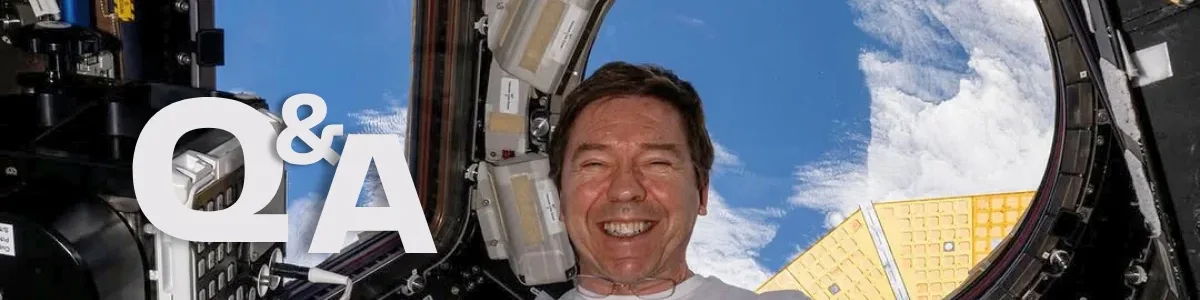
We had the honour of sitting down with Mike Barratt to explore some of the most pressing questions in space medicine, from the realities of practising beyond Earth to the assumptions that begin to break down the moment you leave it behind.
What quickly became clear is that space medicine isn’t simply a more extreme version of what clinicians already understand, it is something fundamentally different.
Why Space Medicine Changes Everything
What happens when the assumptions behind medicine stop holding up?
In this conversation, astronaut and physician Mike Barratt explores the realities of practising medicine beyond Earth, where physiology changes, evacuation becomes uncertain, and clinicians operate without the safety nets terrestrial medicine depends on.
Across multiple missions and more than 400 days aboard the International Space Station, Mike shares first-hand insight into how space fundamentally changes the way medicine works.
This discussion offers a rare insight into one of the most operationally demanding forms of medicine currently practised, and how human spaceflight is forcing medicine to evolve beyond many of its traditional assumptions.
“There’s just a lot of space in space medicine… and simply strong clinical knowledge, even in extreme environments, is just not enough.”
As an astronaut and a physician, and is board-certified in both Internal and Aerospace Medicine, Mike isn’t speaking about space medicine from theory. Across multiple missions, including long-duration stays aboard the International Space Station, he has spent over 400 days in space.
Alongside this, he has worked extensively as a flight surgeon and helped shape medical operations for human spaceflight programmes. So when he talks about medicine beyond Earth, what comes through is real lived experience.
And one of the first things he challenges is the idea that space medicine is simply an extension of what clinicians already know.
“There’s just a lot of space in space medicine… and simply strong clinical knowledge, even in extreme environments, is just not enough.”
That gap between expectation and reality is where things start to get really interesting…
You’re not treating a “normal” patient anymore
A useful starting point is to let go of the assumption that you are dealing with a standard human physiology under stress. In space, the body doesn’t just struggle against the environment, it adapts to it in ways that fundamentally shift what “normal” looks like.
Mike describes this shift very clearly.
“You’re not dealing with a normal person in an extreme environment… you’re dealing with someone who’s gone through many different adaptive physiologic changes.”
One of the most striking examples is the way the cardiovascular system responds to microgravity. Within a relatively short time, astronauts lose around 15% of their circulating plasma volume, alongside a comparable reduction in red blood cell mass.
Clinically, this begins to resemble a haemorrhage model, but crucially, it isn’t pathology, but a new baseline. That distinction becomes critical when something goes wrong.
“If you actually do have a haemorrhage event, then you’re kind of at the edge of a volume cliff… and when you replenish, you’re trying to get back to a new zero gravity norm, not terrestrial norms.”
In practical terms, this means that clinical judgement has to adapt alongside physiology. The reference point has shifted, and applying Earth-based expectations without accounting for that can lead to the wrong decisions being made for the right reasons.
The chain of care disappears
Much of terrestrial emergency medicine is built on the assumption that care is sequential. Stabilise the patient, transfer them, escalate to definitive care. Even in expedition environments, there is usually some form of evacuation plan, however complex or delayed.
Space removes that structure almost entirely.
“You’re not part of an extensive chain that’s well oiled… you really have to consider that you’re on your own.”
This is one of the most important conceptual shifts. The clinician is no longer a single link in a broader system but is instead operating within a closed loop, where the options available are defined entirely by what is already onboard.
Evacuation does exist, but it is rare, high-risk, and not something that can be relied upon in the same way as terrestrial retrieval systems. That changes the nature of decision-making.
It becomes less about stabilisation for transfer and more about managing a problem over time, often with incomplete information and finite resources.
Preparation replaces improvisation
There is a tendency to associate extreme environments with improvisation, with the idea that the best clinicians are those who can adapt in the moment. What Mike describes is something far more deliberate.
Preparation begins with identifying knowledge gaps and pushing understanding right up to those limits.
It extends beyond medical knowledge into a detailed familiarity with every available resource, including tools that may not have been designed for clinical use but could become relevant in an emergency.
Simulation plays a central role in this process.
“One pre-flight sim… had a combination of a medical problem and a piloting problem… and in one of my flights I was in a situation that was actually very similar.”
The value of that preparation is not just technical competence but cognitive familiarity. When a real situation unfolds, it is not entirely new. It carries a sense of recognition, which reduces uncertainty and allows for more controlled decision-making.
Prevention is not optional
If there is one theme that underpins everything Mike discusses, it is prevention.
“First and foremost… the most critical one… is prevention. Prevention, prevention.”
In an environment where resources are limited and recovery options are constrained, avoiding a problem is often more important than managing it effectively once it occurs.
This requires continuous awareness of multiple interacting systems: the crew, the vehicle, the environment, and the mission itself. It involves anticipating how small changes might translate into health risks and intervening early, often before a situation would be considered clinically significant on Earth.
Medicine exists within the mission
Another shift that can feel unfamiliar is the role of the mission in shaping clinical decisions. On Earth, patient care is typically the primary objective. In space, that objective sits alongside another.
“We don’t fly people in space to keep them healthy and safe… we fly because we have a mission.”
This does not diminish the importance of clinical care, but it does mean that decisions are made within a broader context. The health of the individual, the capability of the crew, and the success of the mission are all interlinked.
As a result, clinical judgement incorporates factors that are not traditionally part of medical training, including operational priorities and risk-benefit considerations at a mission level.
The psychological burden we haven’t yet faced
Some of the most challenging aspects of space medicine are those that have not yet been experienced directly.
One example Mike highlights is the death of a crew member during a mission. While fatalities have occurred during launch and re-entry phases of spaceflight, a death in orbit has not yet happened.
“That would be crew fatality… and that is underestimated because we’ve simply never had to deal with that in flight.”
The difficulty lies not only in the clinical management of such a situation but in its wider impact. The psychological effect on the crew, the operational disruption, and the absence of external support systems combine to create a scenario that is difficult to fully prepare for.
“You simply cannot fully prepare for this event… the ripple effects would just be huge.”
Space medicine as the extreme end of expeditionary care
There are clear parallels between space medicine and expedition medicine, particularly in terms of working with limited resources, managing risk, and operating in challenging environments.
“Space medicine is just another expeditionary venue… but with its own set of norms and particular hazards.”
The distinction lies in the removal of safety nets. There is no straightforward evacuation pathway, no rapid escalation to higher levels of care, and no margin for delay. The same principles apply, but they are applied in a context where the consequences of error are more immediate and less forgiving.
Technology supports judgement, it doesn’t replace it
As space missions become longer and more complex, the role of autonomous systems and advanced diagnostics is increasing. However, Mike is clear that this does not replace the need for clinical judgement.
“You have to be very sceptical of the outputs… you as a medical officer are extremely responsible for a high stake decision.”
The limitations of data, the variability of human response, and the high stakes involved mean that clinicians remain central to decision-making. Technology can extend capability, but it cannot remove responsibility.
Looking ahead
With missions such as Artemis II pushing beyond low Earth orbit, the demands on space medicine are evolving. Greater autonomy, longer mission durations, and increased exposure to unfamiliar environments will require a continued shift in how medical care is approached.
For clinicians, this represents both a challenge and an opportunity. It is a field that requires commitment, cross-disciplinary thinking, and a willingness to operate outside traditional frameworks.
Learn more
For those interested in exploring these ideas further, our Space Medicine Course brings together experts like Mike Barratt to examine how medicine functions in environments where many of the usual assumptions no longer apply, from physiological adaptation to decision-making under constraint.
Find out more & secure your place.
And finally, a massive thank you to Mike Barratt for taking the time to answer these questions and share his experience so openly (just make sure he always has access to coffee).
→ Join us in Muncaster Castle for Space Medicine 2026
→ Sign up to our mailing list to learn more about extreme medicine.